Hopefully it did not involve crossing a gangway across open sea from a pitching and rolling vessel to a small doorway some metres away
However, that’s the reality for the growing number of engineers and technicians servicing Europe’s offshore wind industry. Recent Rolls-Royce developments in DP systems have been centred on improving these working conditions and have contributed to the award winning UT 540 service operation vessel (SOV) specifically designed for windfarm support activities in shallow waters.
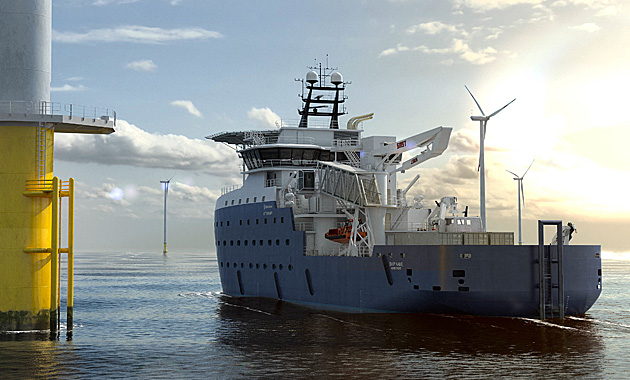
The three model UT 5400-series has been developed to serve as the base for wind turbine technicians while they perform maintenance. The first UT 540 was ordered in 2015 by Østensjø Rederi to support work on DONG Energy’s Race Bank offshore windfarm, 27km off the coast of Lincolnshire, UK. The company has now ordered a second vessel to work on DONG Energy’s Hornsea Project One windfarm, 120km off the UK’s Yorkshire coast in the North Sea.
The 81m SOV can accommodate up to 40 wind turbine technicians and has to ferry six to eight maintenance teams to and from a similar number of wind turbines at the start and end of each shift. Therefore, there is only about 20 minutes for each delivery or collection.
Technicians walk-to-work across a specially designed motion compensated gangway, which is hydraulically raised or lowered on a pedestal, to give safe and level access to the turbine platform at different states of the tide.
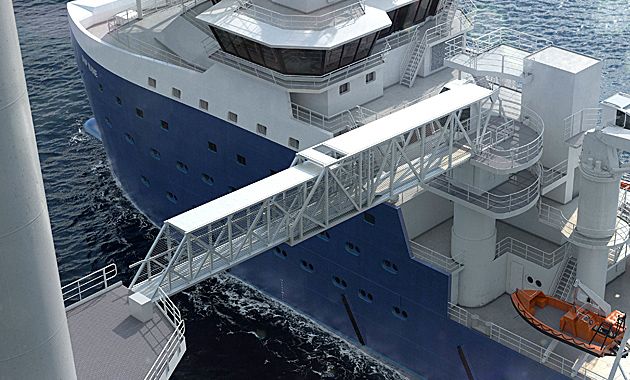
To enable safe working in close proximity to the turbine towers the UT540 is equipped with DP2 dynamic positioning. But the role of the vessel and the consequent demands on the DP system are very different from those in the offshore industry where the DP system was developed.
“With only 20 minutes to complete each collection or delivery, a DP system able to establish optimum performance very quickly on arrival is essential to fulfil the vessel’s design brief,” says Arnt-Ove Austnes, General Manager Sales - Electrical, Automation & Control.
By comparison, in the offshore sector there are often site specific operational guidelines which state a vessel has to be on DP for half an hour or so outside a 500m zone, before approaching the platform and conducting its mission.
“In effect,” adds Austnes, “for windfarm support we’re doing this twice as fast as we’ve done previously.”
“At the heart of a DP system,” according to Frode Bloch, Technical Product Manager – positioning & thruster controls “is a complex mathematical model using a combination of data to position the ship. In the case of the Race Bank array, the vessel uses GPS and lasers fired from a spinning unit at the top of the vessel and reflected back from discs on the turbine together with weather and current information (the vessel has a current profiler installed which sends this information to the DP system) to carry out its role.
This takes time and to meet the vessel’s schedule we had to speed up this process up whilst maintaining the system’s integrity using some additional mathematics, which has further developed the system’s already advanced software.”
The DP system also needs to be integrated with the operation of the gangway. As the gangway is not a permanent connection it cannot be used as a positioning reference, but still needs monitoring by the crew using a panel on the DP user interface.
Once the turbine transfer operation is concluded the DP system undertakes the vessel’s transit phase, moving to the next turbine at up to 13knots powered by four 4000-series MTU diesels. This requires a rapid change of function for the DP system from station keeping to navigation. According to Austnes, “the customer is looking to undertake a fully automated operation.”
After deploying the maintenance teams, the vessel has to wait several hours whilst the work is undertaken, before collecting them at the end of the shift. During that time, the vessel takes advantage of another DP function ‘weather optimal positioning’. This automatically maintains the vessel’s ideal position in relation to the prevailing weather using the minimum number of thrusters and consequently saving fuel.
According to Johan Rokstad, Østensjø Rederi CEO, the UT 540 “enables us to expand our business into the renewable energy sector. It has been our strategy to diversify our operations and we believe the sector holds further demands for similar vessels in the near future.”
“When building a new vessel our focus is to make sure the vessel is optimised for the operation it is set to perform. In choosing a collaborative partner, we look for someone who can incorporate innovative solutions, efficient hull design and positive environmental effects into the design. For this project we chose a Rolls-Royce design. The new vessel is the result of a positive collaborative process with the team at Rolls-Royce. Our requirements have been transformed into an SOV vessel that will provide a safe and efficient walk-to-work experience for our wind technicians.”
A simulation of the windfarm vessel will be part of the Rolls-Royce stand at SMM and can be viewed in our digital edition.