Decades of experience in studying hydrodynamics and cavitation are vital in meeting those critical customer requirements, especially when they are on the edge of known knowledge
 “When Feadship asked us to provide the propulsion for their innovative new ‘Breathe’ hull design requiring a number of different propulsion modes for different conditions, we weren’t sure it could be done,” says Göran Grunditz, Manager of the Rolls-Royce Hydrodynamic Research Centre in Sweden (pictured left). “We’d been researching contra-rotating propulsion on and off for over 30 years, but we knew we had not delivered something this radical before and there were still a number of risks to mitigate.”
So began a 5-year programme, which combined state-of-the-art hydrodynamic research with the development and adoption of ground breaking new design tools.
The result sits below a striking new vessel the 83m Feadship Savannah, which claims to be the first hybrid motoryacht. Featuring an eco-friendly blend of single diesel engine, three gensets, batteries, CP propeller, azimuth thruster and a streamlined hull shape, the vessel offers improved fuel economy of 30 per cent, quiet cruising at low speeds on battery power and extra speed when going flat out. Further innovation includes a floating superstructure, an underwater lounge and ‘open’ aft deck areas.
Unique product combination
The Rolls-Royce contribution to the vessel’s pioneering electro-mechanical propulsion platform was a unique combination of a number of existing but separate products in a new way.
A large CP propeller, rotating in a counter clockwise direction, when viewed from aft, was installed in front of an Azipull unit with its propeller rotating in the opposite, clockwise direction to create a contra-rotating propulsion system located along the vessels centre line. Operating in the rotational slipstream of the forward propeller, the aft propeller recovers energy from the swirl it creates. This energy would otherwise be lost, making the system more efficient than a conventional twin screw.
The Azipull also provides excellent low speed manoeuvring so there is no need for a tunnel thruster in the aft skeg. That means less drag further contributing to energy saving.
However, the skeg, located in front of the forward propeller also presents a design challenge. It creates a reduced water flow over the first propeller. This improves the overall efficiency of the vessel, but the flow is non-uniform and at the propeller causes noise and vibration. That meant a special, bespoke propeller design was required to maximise efficiency with minimum noise.
Back to the future
“To develop the system we began by reviewing the existing research which had been done, going back as far as the 1980s,” says Grunditz.
A key challenge identified was the extent of the dynamic loads the configuration placed on the aft propeller blades that operate in the slip stream of the forward one. They were identified as being at their worst when the Azipull is being used to steer. These dynamic loads could increase wear on internal bearings and gear wheels causing them to fail prematurely, and could even damage propeller blades.
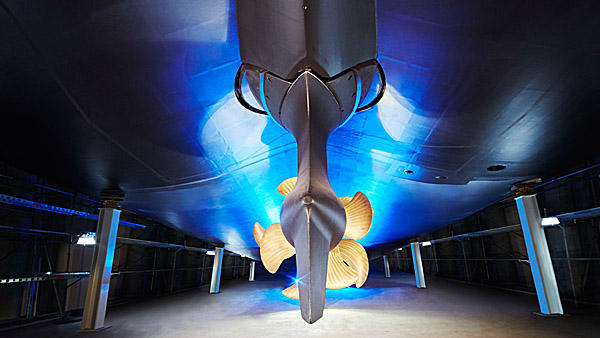
One of the factors that helped solve this is that in contra-rotating mode at high speeds the Azipull does not steer, separate rudders are used. The rudders also limit the freedom of movement of the Azipull at speed further reducing the risk of high dynamic load.
At slow speeds and when operating in DP the yacht is manoeuvred using the 360° thrust vectoring of the Azipull, whilst the forward propellers are feathered. Therefore excellent maneuverability is provided with marginal impact from the forward propeller.”
Designers also worried about the way in which the natural frequency of the Azipull corresponds to the blade pass speeds of the propeller. A contra-rotating propeller uses a lower than normal shaft speed and experiences different excitation frequencies compared to a conventional propeller. This means that the torque is higher for the same power, which can lead to lower safety margins of gearwheels when dynamic loadings are considered. In this case, investigations indicated that in some operational modes the blade pass rotational speed was quite close to the natural frequency of the Azipull, which could result in vibration and noise.
To mitigate this Rolls-Royce designers worked with the yard and another specialist supplier to mount the Azipull on robust custom designed elastic supports, something never done before. The special supports reduced the impact of vibrations caused by the propeller and were confirmed as effective during sea trials. Studies found some resonances but they were all low in magnitude, so there was no need for any restrictions, such as RPM.
Research and design tools:
Rolls-Royce designers made extensive use of innovative Computational Fluid Dynamic (CFD) tools to design and validate the propulsion system.
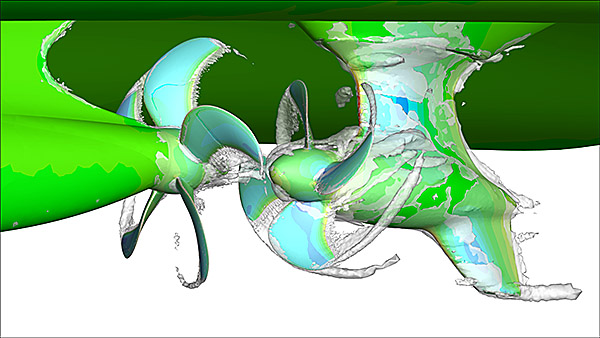
“We developed a tool to evaluate the performance of the CRP set up; predicting efficiency for combinations of propeller pitch and RPM,” says Rikard Johansson, Senior Hydrodynamicist. “This tool was validated against model tests carried out in our own cavitation test facility in Kristinehamn. Conventional design tools could not do this because of the influence of the swirl. The combination of advanced CFD methods, validated by cavitation testing at model scale allowed us to estimate the optimum power distribution for the forward and aft propeller, optimum shaft speeds and propeller pitch for both, giving a starting point for detailed design.”
Another set of design tools were used for the detailed design, which took account of propeller interaction effects.
“CFD tells us a lot,” adds Johansson. “We found additional information from CFD simulations. We used it to explore the interaction between the hull and the contra-rotating propellers so dynamic loads on the Azipull could be predicted and understand the implications of swirl on the rear propeller. It also allowed us to go through multiple design loops before arriving at the optimum design, which was then model tested, saving time and money. Model testing validates the fundamental physics of the CFD model, which enables us to trust our simulation results. A particular strength of Rolls-Royce is our ability to combine CFD with testing.”
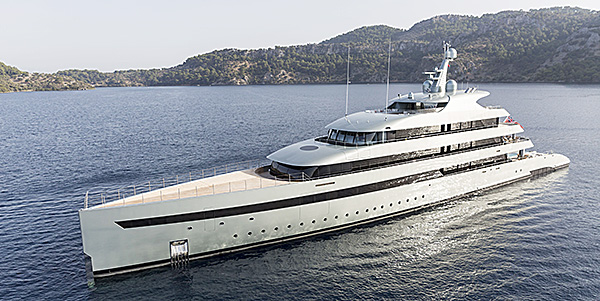
The number of variables explored in the design of the propulsion system and its complexity cannot be understated. The Savannah has a number of propulsion modes for different operations – boost, high speed, diesel-electric, manoeuvring and stationary. Therefore the control system was designed to switch between these modes seamlessly, ensuring passengers were not disturbed by any noise and vibration, which sea trials confirmed. Achieving this added significant complexity to both the control system and associated hydrodynamics, which had to be clearly understood before the system’s on-board controller could be programmed for optimum performance.
“Rolls-Royce is probably the only company that could have developed and produced this ground breaking system for this innovative vessel,” says Grunditz. “It required an extensive primary research base built up over years, the ability to develop innovative computer design tools, undertake experimental validation and turn the design into a physical reality which could be manufactured, installed and operate.”