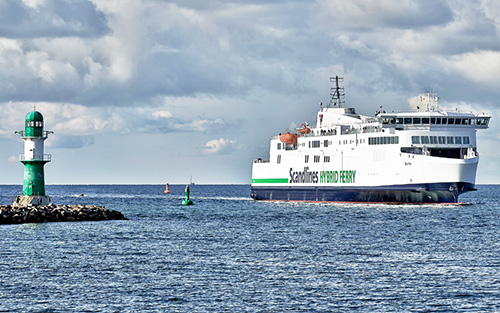
Once both of Scandlines’ new passenger vessels are in service between Denmark and Germany, the choice of Rolls-Royce propulsion system will help to double capacity on a challenging route between Scandinavia and Germany.
MF Berlin is the first of two new modern passenger and freight hybrid ferries to enter service this year for the German-Danish ferry operator Scandlines. When sister vessel MF Copenhagen enters service later this year on the Gedser-Rostock route between Denmark and Germany, the two new ferries – together with additional improvements at the terminals – will double the transport capacity on this vital route between Scandinavia and Europe.
 Optimum efficiency
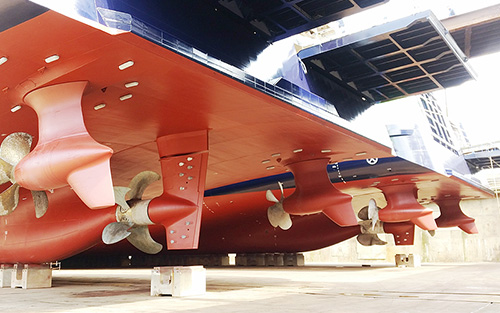
That improvement is due in no small part to the innovative Rolls-Royce propulsion system that provides the ferries with efficient propulsion in transit and agile manoeuvring in harbour. Berlin and its sister can carry 1,300 passengers in considerable comfort and the equivalent of 460 cars or 96 trucks. Both were designed specifically for the route and feature a centreline CP Promas propeller/rudder and two wing Azipull thrusters.
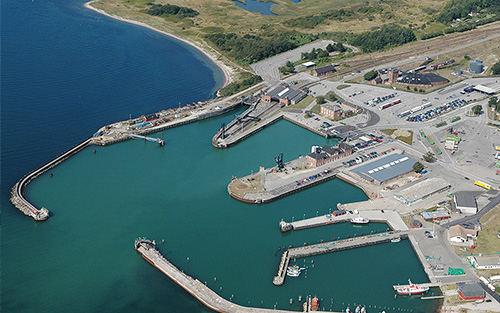
The vessel length of 169.5m with a draught of 5.5m is optimised for Gedser harbour at the Danish end of the route, and the design of the hull has taken into account the shallow water on the entire 26 nautical mile run. Within Gedser harbour, the water depth is only about 7.5m, and the depth varies between 14 and 21m over the rest of the route. Another complicating factor is the strong across current at the opening between the piers at Gedser.
The operating strategy is therefore to accelerate rapidly to nine knots astern when leaving Gedser, then turn the vessel once outside the port, proceed to Rostock, and turn again before entering berth stern first. On the return trip, the ferries will go ahead from berth to berth. As part of the investment, the ferry piers and ramps have been rebuilt at both terminals to reduce turnaround times. Transit speeds that give optimum fuel economy can be adopted for the given departure frequency of 20 departures per day in a fixed two-hour cycle, which means around 19 knots for a 105-minute passage time.
Focus on manoeuvrability and speed
This way of operating puts the focus on manoeuvrability and speed, and hence the design of the Rolls-Royce propulsion solution. The two wing Azipull azimuth thrusters are in operation at all stages of the voyage, each driven by a 3,500kW electric motor. They allow large turning forces to be exerted on the vessel, stationary or moving. When reversing off the berth and out between the harbour piers at Gedser and dealing with the cross currents, the Azipulls are rotated for full astern thrust to give precise course keeping and will accelerate the ferry from standstill to nine knots in less than three ship lengths.
In transit, the thrusters deliver efficient forward thrust. For manoeuvring and at lower speeds, the centreline CP propeller is feathered. Once the ferry’s speed reaches 17 knots, the propeller is set to the freewheeling pitch and clutched in. The centre shaftline then supplies the additional propulsion thrust needed for full transit speed, driven through a combining reduction gearbox. Two generator sets, two main engines and a battery pack provide a total of 18MW to the propellers and the hotel load.
The Helicon X3 control system adjusts propeller pitch and speed, and determines the power fed to the azimuth thrusters, to give the optimum power split of 40 per cent of the total equally divided between thrusters, and 60 per cent to the centreline controllable pitch propeller. To maximise propulsive efficiency and reduce cavitation induced pressure pulses, the Promas system has a five-bladed propeller.
The rudder, with a Costa bulb and a twisted leading edge, recovers swirl energy in the propeller slipstream that would otherwise be lost, converting it into additional forward thrust. The Promas is also a low-drag solution in the feathered position, and the five-bladed monoblock propellers on the Azipull units are designed to provide high propulsive efficiency up to 17.5 knots. This innovative solution was designed after extensive mathematical modelling and test tank work, with input from Scandlines, Rolls-Royce and the test tank establishment in Hamburg, HSVA.
Evaluating performance
Model testing was also undertaken in Duisburg, where the tank could be configured to evaluate performance in shallow waters. Small underkeel clearance can give rise to propeller wear or damage. To minimise this, the thrusters are positioned close up under the hull, the CP propeller diameter is limited to 4.6m, and the bottom of the hull is dished to give more clearance over the propeller.
As the ships run at speed in shallow waters, cavitation and pressure pulses were analysed in detail to ensure they met passenger vessel noise criteria. The propulsion system complies with Lloyd’s Register Ice Class 1C rules, and FEM analysis was used in propeller design, to meet the new Finnish/Swedish rules which require blade strength to be calculated against a stated ice loading.
Environmental considerations
Environmentally friendly power for propulsion and hotel load is provided by four diesel engines with combined scrubbers, one less than a non-hybrid design, integrated with a 1.5MWh energy storage system of lithium polymer batteries. These new ferries now join the Scandlines fleet, which is the largest fleet of hybrid ferries in the world.
The ferries were completed in the Danish shipyard Fayard, and represent an investment of more than €140 million (£114m) per vessel. Together with the expansion of the port facilities, the ferries will complete Scandlines’ strategic focus on expanding the central and eastern transport corridor between the European mainland and Scandinavia.