Submarines
Capability
Within the Rolls-Royce submarines business, over 1,300 engineers play key roles in the design and support of the nuclear propulsion plant on board the current fleet of Trafalgar and Vanguard class submarines and new Astute class submarines.
In 2012 a contract was awarded by the MoD covering the continued operation and maintenance of the core manufacturing facility at Raynesway in Derby and the complete regeneration of the existing facility.
As a further signal of the long-term commitment to the submarine programme, in 2013 MoD and Rolls-Royce signed a ten-year Foundation Contract to deliver cost savings of up to £200 million to the customer in the provision of nuclear propulsion systems for the UK’s existing and future submarine flotilla.
The new working arrangements respond to the Ministry’s requirement for closer co-operation from its contractor base to better manage costs, as part of the Submarine Enterprise Performance Programme.
To fulfil the NSRP technical authority role we employ specialists in many engineering disciplines.
- Engineering disciplines
- Design
- Stress analysis
- Structural integrity assessment
- Safety case development
- Non-destructive examination (NDE)
- Thermo-hydraulic analysis
- Materials
- Chemistry
Submarine development
Early submarines used petrol engines and later diesel engines to charge their batteries. The arrival of nuclear power in the 1950s, requiring no air to operate, freed submarines from the oceans surface enabling them to operate independently and unseen in their true environment. The submariners ability to live submerged for long periods and the food that could be carried became the new limits on a submarines endurance.
There are currently two submarine types - Ship Submersible Nuclear (SSN) or attack submarine and Ship Submersible Ballistic Nuclear (SSBN) or deterrent submarine.
Features
- Each generation of reactor plant has seen improvement in stealth for the submarine
- Long-life core lasts the entire life of the submarine eliminating costly mid-life refuelling
- Allows submarines to operate for long periods submerged only restricted by food on board
- Designed by Rolls-Royce on behalf of the MoD
Submarine propulsion
We are the pioneer of one of the most important technological advances in naval propulsion - the use of nuclear propulsion for the Royal Navy's submarine flotilla. As the UK Technical Authority for the Nuclear Steam Raising Plant, we manage all aspects of the plant design, safety, manufacture, performance and through-life support.
.
This role is undertaken in close co-operation with the Ministry of Defence to achieve maximum benefits to the submarine programme - improving affordability, reliability, availability, and sustainability. Safety support covers the complete plant life cycle from new build and plant life extension to decommissioning, and includes the provision of integrated whole submarine safety.
The British Naval programme has seen five new core designs pass from concept into manufacture at Rolls-Royce. Three core designs were developed for the basic PWR1 plant with two further designs developed for the larger PWR2 plant.
PWR1 - Pressurised Water Reactor - was the first reactor plant designed and manufactured by Rolls-Royce for the British nuclear submarine programme. Through its life it was regularly updated in the quest for improved performance with quieter operation. The design evolution spanned three reactor core designs, all designed and manufactured in Derby. The first core based on an American design was fitted to Valiant and Resolution classes of nuclear submarines.
PWR2 - The larger PWR2 plant was designed to meet the operational requirements of the larger Vanguard class submarines. The steady evolution in reactor design has culminated in the long-life core, which began shore based testing in 2002. The latest core has over six times the energy output and over four times the service life of the original. These long-life cores are now fitted in the latest Astute and Vanguard class submarines
PWR3 - This reactor design is being developed as part of the Successor programme to replace the existing Vanguard class of submarine. The PWR3 plant will a deliver huge improvement in terms of safety, integrity and availability, while at the same time reducing the through-life costs; a major part of the SEPP commitments made by Rolls-Royce.
Shore-based testing
For over 40 years Vulcan has been the cornerstone of the Royal Navy’s nuclear propulsion programme, testing and proving the operation of four generations of reactor core
.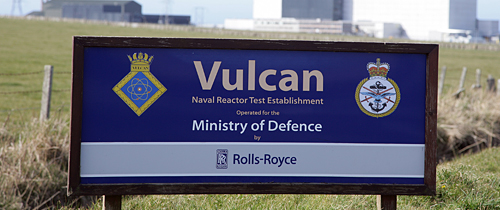
The test facility saw the first operation of all PWR1 and PWR2 Royal Navy reactor core types. Its reactors have significantly led the operational submarine plants in terms of operating hours, proving systems, procedures, and safety. The testing of the first long life core commenced in 2002 and continues to provide important data to Rolls-Royce and the MoD regarding core performance.
Vulcan has adopted many different roles in support of the UK’s submarine fleet over the years, including:
- Test bed for evolving reactor technology.
- Proving plant for sea-going equipment.
- Training facility for nuclear submarine engineers.
- Test rig for equipment including main coolant pumps
- Equipment overhaul
Secondary propulsion equipment
Rolls-Royce provides a range of equipment specifically for submarines. Dedicated teams deliver the nuclear systems and support for the Royal Navy’s submarine flotilla, while others are developing a growing range of non-nuclear systems and services for international markets.